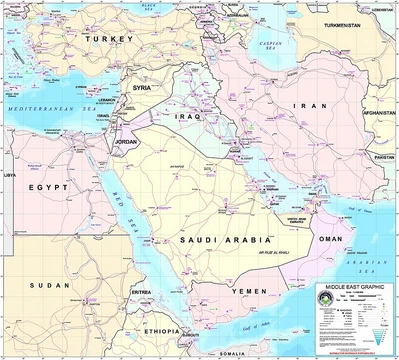
Iran–Iraq War
Deadliest conventional war between developing countries.

The Iran–Iraq War, also called the First Imposed War by Iran, was a conflict that began with the Iraqi invasion of Iran in September 1980 and lasted eight years, ending with a United Nations-brokered ceasefire in August 1988. The war involved large-scale trench warfare, deliberate attacks on civilians, and Iraqi chemical attacks, and resulted in no permanent border changes or war reparations.
- start
- September 1980
- end
- August 1988 (ceasefire)
- type
- Conventional war
- belligerents
- Iraq vs. Iran
- outcome
- Stalemate; no border changes
Lore & Background
The war began when Iraq, led by President Saddam Hussein, invaded Iran primarily to prevent Iran's new state ideology under Ruhollah Khomeini from spreading to Iraq, and to retake the eastern bank of the Shatt al-Arab river ceded in the 1975 Algiers Agreement. Iraq also feared Iran would rally Iraq's Shia majority against the Sunni-led Ba'athist government, and sought to replace Iran as the main Persian Gulf power.
Reader's Guide
The Iran–Iraq War is significant for its immense human cost and its demonstration of how post-revolutionary chaos can invite aggression. Iraq's initial invasion stalled by December 1980, and Iran recaptured all its territory by June 1982, then launched a five-year offensive into Iraq. Iraq's counter-offensives in mid-1988 created a stalemate. The war saw extensive use of trench warfare and chemical attacks, and involved numerous foreign backers: Iraq was aided by the United States, the United Kingdom, the Soviet Union, France, and most Arab countries, while Iran was aided by Syria, Libya, North Korea, China, and Israel. The war ended with no territorial changes or reparations, and low-level conflict continued until Saddam's overthrow in 2003.
Did You Know?
- Iraq used chemical attacks against civilians during the conflict.
- The war began with Iraq's invasion in September 1980 and ended with a UN-brokered ceasefire in August 1988.
- Neither country received war reparations after the conflict.
Origins and Ideological Stakes
The decision to launch the September 1980 invasion was driven by a convergence of ideological fear, territorial grievance, and regional ambition. Saddam Hussein viewed the post-revolutionary Islamic Republic as an existential danger: Khomeini's calls for the overthrow of the Ba'athist regime threatened a government whose Sunni leadership already faced pressure from its own Shia majority. Baghdad also remembered the 1975 Algiers Agreement, which had ceded the eastern bank of the Shatt al-Arab to Tehran, and saw war as a chance to reverse that loss. The immediate trigger sharpened in April 1980, when an Iran-linked group attempted to assassinate Deputy Prime Minister Tariq Aziz; Iraq responded by executing the prominent Shia cleric Muhammad Baqir al-Sadr and his sister. Behind these flashpoints lay a longer strategic calculation. Saddam sought not merely to defend borders but to displace Iran as the dominant Persian Gulf power and to position Iraq as the successor to Egypt as the Arab world's leading state.
The Shape of the Fighting
What began as what Baghdad expected to be a swift punitive campaign quickly became the longest and most destructive conventional war ever fought between the regular armies of developing nations. Iraqi forces crossed into Iran in September 1980, counting on the disarray of a country still reeling from revolution, yet the advance had ground to a halt by December. Over the following months the Iranian military regrouped and, by June 1982, had pushed Iraqi troops back across the pre-war frontier. Rather than consolidating, Tehran chose to cross into Iraqi territory, opening a five-year series of offensives that stretched resources on both sides to the breaking point. The fighting took on a grim, static character: vast trench networks lined the front, and both sides carried out deliberate strikes against civilian populations. Iraq deployed chemical weapons against Iranian soldiers and towns, an escalation that drew little meaningful international condemnation. By mid-1988, a fresh wave of Iraqi counter-offensives locked the front into the stalemate that would define the war's end.
A Web of External Sponsors
The conflict was never purely bilateral; it became a proxy theater in which nearly every major power found a reason to tilt. Iraq drew material and political backing from an unusually broad coalition: the United States, the United Kingdom, the Soviet Union, France, Italy, Yugoslavia, and the majority of Arab states all extended support in various forms. The National Council of Resistance of Iran, a domestic opposition group, also received Iraqi encouragement, as did Arab separatist movements inside Iran. On the Iranian side, assistance came from Syria, Libya, North Korea, China, South Yemen, Pakistan, Cuba, and even Israel, alongside the two major Kurdish parties, the Kurdistan Democratic Party and the Patriotic Union of Kurdistan. This patchwork of sponsors meant that diplomatic channels were as contested as the battlefield. Iran's acceptance was shaped by mounting military and economic losses, eroding troop morale, the intensifying friction with Washington, and the conspicuous absence of any meaningful international response to Iraqi attacks on Iranian civilians.
An Unresolved Ending
The August 1988 ceasefire did not produce a victor. No borders were redrawn, no reparations were extracted from either side, and both nations emerged financially devastated after eight years of sustained combat. Iran, which had labeled the conflict the First Imposed War, had sacrificed enormous manpower and economic capacity in a prolonged offensive that never achieved its strategic objectives. Iraq, despite having initiated the war, had likewise bled its treasury and its population. The underlying grievances that had fueled the invasion, the Shatt al-Arab question and the ideological rivalry between a theocratic Shia state and a Sunni Ba'athist republic, remained formally unresolved. Low-level armed clashes continued along the shared frontier for years after the guns fell silent. It was not until the 2003 overthrow of Saddam Hussein that the two countries began a genuine process of normalizing relations. In the interim, the war's legacy persisted in the scars of trench lines, the memory of chemical attacks, and the economic hollowing of two neighbors who had once been, briefly in 1978, on the verge of cooperation.
Frequently Asked Questions
What is the Iran–Iraq War?
It was an eight-year conventional conflict in which Iraq invaded Iran in September 1980, a war Iran itself labels the 'First Imposed War.' The fighting finally stopped when a United Nations-brokered ceasefire took effect in August 1988.
How does the Iran–Iraq War's story end?
Neither side achieved a decisive military victory; the conflict simply ground to a halt under a UN-mediated ceasefire in August 1988. The final outcome was a stalemate with no permanent border changes and no war reparations levied on either party.
Why is the Iran–Iraq War important?
It produced around half a million deaths, making it the bloodiest conventional war between developing-country armies on record. Its legacy also includes the large-scale use of chemical weapons and the demonstration that entrenched, attritional warfare could still dominate battlefields in the late twentieth century.
What makes the Iran–Iraq War's tactics distinctive?
The fighting relied heavily on vast trench systems and deliberate strikes on civilian infrastructure, echoing patterns last seen in World War I. Iraq additionally deployed chemical agents against Iranian soldiers and Kurdish civilians, marking one of the first modern conflicts to use such weapons at scale.
More in Modern Conflicts 1-15
Spotted an error? Know more?
This is a living reference — every entry is fact-audited, and reader corrections feed straight into our audit queue. Suggest an edit · See this site's audit record