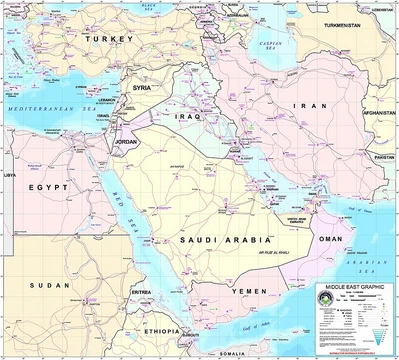
Arab–Israeli conflict
Conflict between Israel and Arab states over Palestinian land.

The Arab–Israeli conflict is a long-running political and military struggle between Israel and surrounding Arab countries, rooted in the competing national aspirations of Zionism and Palestinian Arab nationalism. It began with the rise of these movements in the late 19th century and escalated into open warfare after the establishment of Israel in 1948, shaping the modern Middle East.
- start_date
- Late 19th century (roots); 1948 (first major war)
- key_events
- 1948 Palestine war, 1956 war, 1967 war, 1973 war, 1982 war, First Intifada (1987–1993), Second Intifada (2000–2005), October 7 attacks (2023)
- parties
- Israel, Arab countries, Palestinian factions
- territories_involved
- Palestine, Israel, West Bank, Gaza Strip, Golan Heights (implied by wars)
Lore & Background
The conflict's origins lie in the late 19th century, when Zionism emerged in Europe and Arab nationalism arose primarily within the Arab world. Jewish migration to Palestine, then part of the Ottoman Empire, began purchasing land from Ottoman landlords. The League of Nations formally approved the Mandate for Palestine in 1922, implementing the Balfour Declaration's support for a Jewish national home, which upset the Arab world.
Reader's Guide
The Arab–Israeli conflict is significant for its duration and impact on global politics. It began as a clash between Zionism and Palestinian nationalism, with Britain's Mandate policies exacerbating tensions. The 1948 war established Israel and created the Green Line, while subsequent wars in 1956, 1967, 1973, and 1982 redrew borders and deepened hostilities. The conflict has involved Palestinian uprisings (Intifadas), the Syrian civil war, and recent violence like the October 7 attacks and Gaza war. Its legacy includes ongoing debates over land, sovereignty, and the rights of Jews and Arabs in the region.
Did You Know?
- The 1948 Palestine war ended with the 1949 Armistice Agreements, which established the Green Line.
- The 1929 riots included the Hebron massacre, where Arabs murdered 67 Jews.
Competing Nationalisms and the Ottoman Legacy
The Arab-Israeli conflict traces its deepest roots to two nationalist movements that crystallized in Europe during the late nineteenth century. Both drew on centuries of collective identity, yet they collided over the same stretch of land. For roughly four hundred years, Palestine had been administered by the Ottoman Empire, a period that ended with the empire's collapse after World War I. The late-nineteenth-century population of Palestine numbered around 600,000, predominantly Muslim Arabs alongside notable Jewish, Christian, Druze, Samaritan, and Baháʼí minorities. Jerusalem at that time was a modest walled city of a few tens of thousands. As Jewish communities began purchasing land from Ottoman landlords and establishing collective farms called kibbutzim, and as the first entirely Jewish city in modern times, Tel Aviv, took shape, friction with the Arab majority intensified. Some scholars link the simultaneous rise of Zionism and Arab nationalism to a corresponding increase in Arab antisemitism, even though medieval antisemitism in Arabic-speaking lands had historically been less prevalent than in Europe.
The Web of Colonial Promises
The diplomatic architecture that shaped the region was forged amid the chaos of World War I. That revolt, guided by T. E. Lawrence and Husayn's son Faysal, proved successful. Prime Minister David Lloyd George and other key figures believed Jewish backing was essential to winning the war, yet the Declaration nonetheless upset the Arab world.
From Partition to the Green Line
The trajectory from intercommunal tension to full-scale war accelerated dramatically in the late 1940s. Following three waves of Zionist migration and decades of sectarian friction under British administration, the United Nations adopted a Partition Plan for Palestine in 1947, which immediately triggered a civil war. On May 14, 1948, Israel declared its establishment; the British Mandate expired at midnight, and Arab regular armies entered the territory the following morning, transforming the conflict into an international war. The fighting concluded with the 1949 Armistice Agreements, which drew the Green Line borders. The violence did not end there. Subsequent wars erupted in 1956, 1967, 1973, and 1982, each reshaping the territorial and political landscape.
Half a Century of Peace Efforts and Renewed Conflict
Over the decades following 1948, diplomatic and military engagements alternated in a complex, often overlapping pattern. Israel intervened in the 1975–1990 Lebanese Civil War to dislodge the Palestine Liberation Organization from Lebanon. Ceasefires and formal diplomatic ties were gradually established between Israel and individual Arab states.
Frequently Asked Questions
What is the Arab–Israeli conflict?
It is a decades-long political and military struggle between Israel and neighboring Arab states, driven by the clashing national movements of Zionism and Palestinian Arab nationalism. Its roots stretch back to the late 1800s, but it erupted into full-scale warfare following Israel's founding in 1948.
Who are the main parties in the Arab–Israeli conflict?
The core participants include the State of Israel, various Arab nations, and Palestinian political and armed factions. Over time the struggle has also drawn in regional powers and international mediators who shape diplomacy and security arrangements.
What are the major turning points in the Arab–Israeli conflict?
Key escalations include the 1948 war, the 1956 and 1967 confrontations, the 1973 war, the 1982 invasion of Lebanon, and the two Intifadas in the late 1980s and early 2000s. More recent flashpoints include the October 7 attacks of 2023 and their ongoing aftermath.
More in Modern Conflicts 1-15
Spotted an error? Know more?
This is a living reference — every entry is fact-audited, and reader corrections feed straight into our audit queue. Suggest an edit · See this site's audit record